
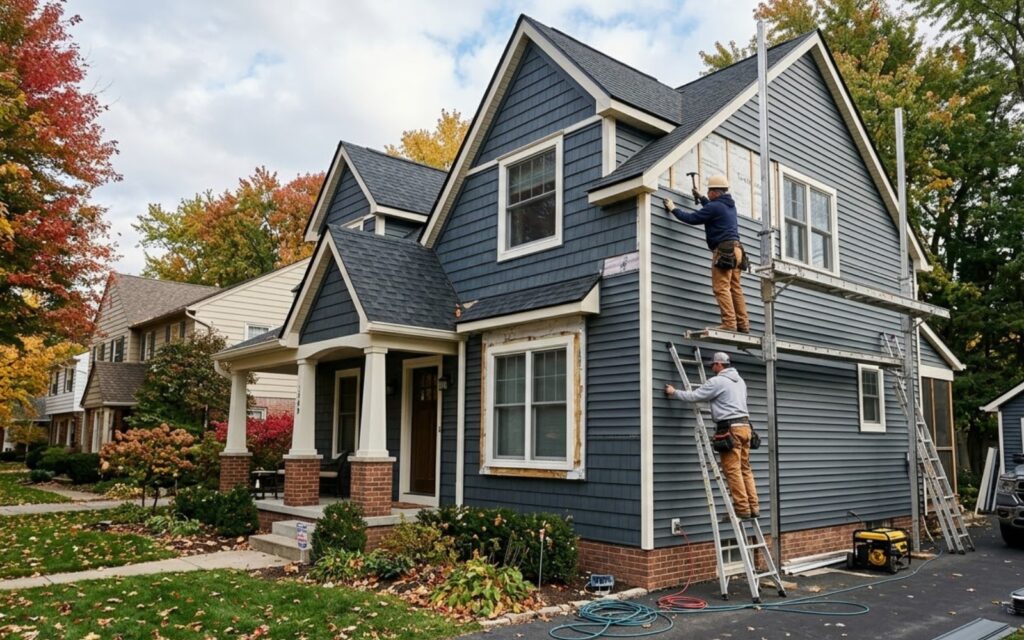
When it comes to home exteriors in Southeast Michigan, the old adage “you get what you pay for” has never been more accurate. For homeowners considering a siding replacement Rochester Hills MI, the initial quote is often the focus. However, looking at the price tag alone ignores the technical specifications that determine whether your siding will last thirty years or fail after the first polar vortex.
In the industry, we distinguish between “builder-grade” materials and “high-gauge” systems. For a home to withstand the extreme temperature swings and high-velocity winds of the Great Lakes region, understanding the science of siding thickness and R-value is essential.
The Gauge Matters: Why Thickness is the Ultimate Protector
Vinyl siding thickness is measured in thousandths of an inch (mils). While the difference between 0.040″ and 0.046″ might seem negligible, it represents a massive leap in structural integrity.
- Builder’s Grade (0.035″ – 0.040″): Often used in low-cost developments, this thin material is highly susceptible to “vinyl rattle”—that annoying chattering sound against your house during a windstorm. It is also prone to cracking during a Rochester winter because the thin plastic becomes brittle when temperatures drop below freezing.
- Standard Residential (0.042″ – 0.044″): A balanced mid-range option, but still vulnerable to high-impact events like hail or a stray baseball.
- Premium High-Gauge (0.046″ – 0.055″): This is the gold standard for residential vinyl siding Rochester Hills MI. High-gauge panels are significantly more rigid. They hang straighter on the wall, hiding minor imperfections in your home’s framing, and offer superior wind resistance—often rated for gusts up to 150 mph.
The R-Value Revolution: Insulated Siding as a Thermal Blanket
Standard vinyl siding has almost no insulating properties (typically around R-0.6). In contrast, insulated vinyl siding features a contoured foam backing that fits snugly behind the panel. This upgrade can boost your wall’s thermal resistance to an R-value of 2.0 to 4.0.
Why does this matter for a Rochester Hills home? It solves the problem of “thermal bridging.” Your home’s wall studs act as a bridge, allowing heat to escape through the walls even if you have insulation between the studs. Insulated siding covers those studs from the outside, acting like a thermal blanket. Homeowners who choose this during their siding replacement Rochester Hills MI often see a 10% to 15% reduction in their annual heating and cooling costs.
Preventing the “Siding Snap”: Cold Weather Flexibility
Michigan winters are famous for the “freeze-thaw” cycle. When temperatures plummet, low-grade vinyl loses its flexibility. If a tree branch or a piece of ice hits a brittle, thin panel, it will snap or shatter.
High-gauge, premium panels are manufactured with advanced “impact modifiers”—chemical additives that keep the vinyl flexible even in sub-zero temperatures. Furthermore, the added rigidity of a thicker panel prevents the “oil canning” or wavy appearance that often plagues cheaper siding after a few seasons of expansion and contraction.
The Silent Benefit: Noise Reduction
Because high-gauge and insulated siding are more substantial, they act as a sound barrier. If you live near a busy road or a noisy neighborhood, premium siding can reduce exterior noise transmission by up to 45%. This creates a quieter, more peaceful indoor environment that you can actually feel.
Frequently Asked Questions
What is the minimum thickness I should accept for siding in Rochester Hills?
We recommend nothing less than 0.044″ (Standard Grade) for our climate, but 0.046″ (Premium) is the safest bet for long-term durability against Michigan winters.
Can you perform a siding repair Rochester MI on high-gauge siding?
Yes. Even though the panels are thicker, a professional siding repair Rochester MI expert can still replace individual sections if they are damaged, though high-gauge siding is much harder to damage in the first place.
Does insulated siding trap moisture against my house?
No. High-quality insulated siding is designed to be “breathable.” It allows water vapor to escape from inside the home while preventing bulk water (rain/snow) from getting in.
How do I know if my current siding is “builder-grade”?
If your siding feels “flimsy” to the touch, rattles when the wind blows, or has visible waves (oil-canning) along the side of the house, it is likely a lower-gauge material.
Is high-gauge siding much more expensive?
The upfront cost is higher, but because it lasts twice as long as builder-grade and saves money on energy bills, the “total cost of ownership” is actually lower over 10–20 years.
Does the color fade faster on thicker siding?
Actually, premium high-gauge siding usually features better UV-inhibitors and “color-through” technology, meaning the color goes all the way through the panel rather than just being a top layer.
Can I add insulation to my current siding without replacing it?
No. The insulation is either built into the panel or installed as a rigid foam board directly before a full siding replacement Rochester Hills MI.
Will high-gauge siding prevent wood rot underneath?
Siding itself is a “water-shedding” layer, not a waterproof one. The real protection comes from the “house wrap” installed underneath, but thicker siding provides a much stronger first line of defense.
How does high-gauge siding handle high winds?
Thicker panels have a reinforced “nailing hem.” This allows the panels to stay locked together and stay attached to the house even in 100+ mph winds.
Is there a specific brand you recommend for Michigan?
We look for brands that offer “Class 4” impact resistance and a “Lifetime Limited Warranty” that includes protection against fading and hail damage.

